
Coaster SDNX #2103
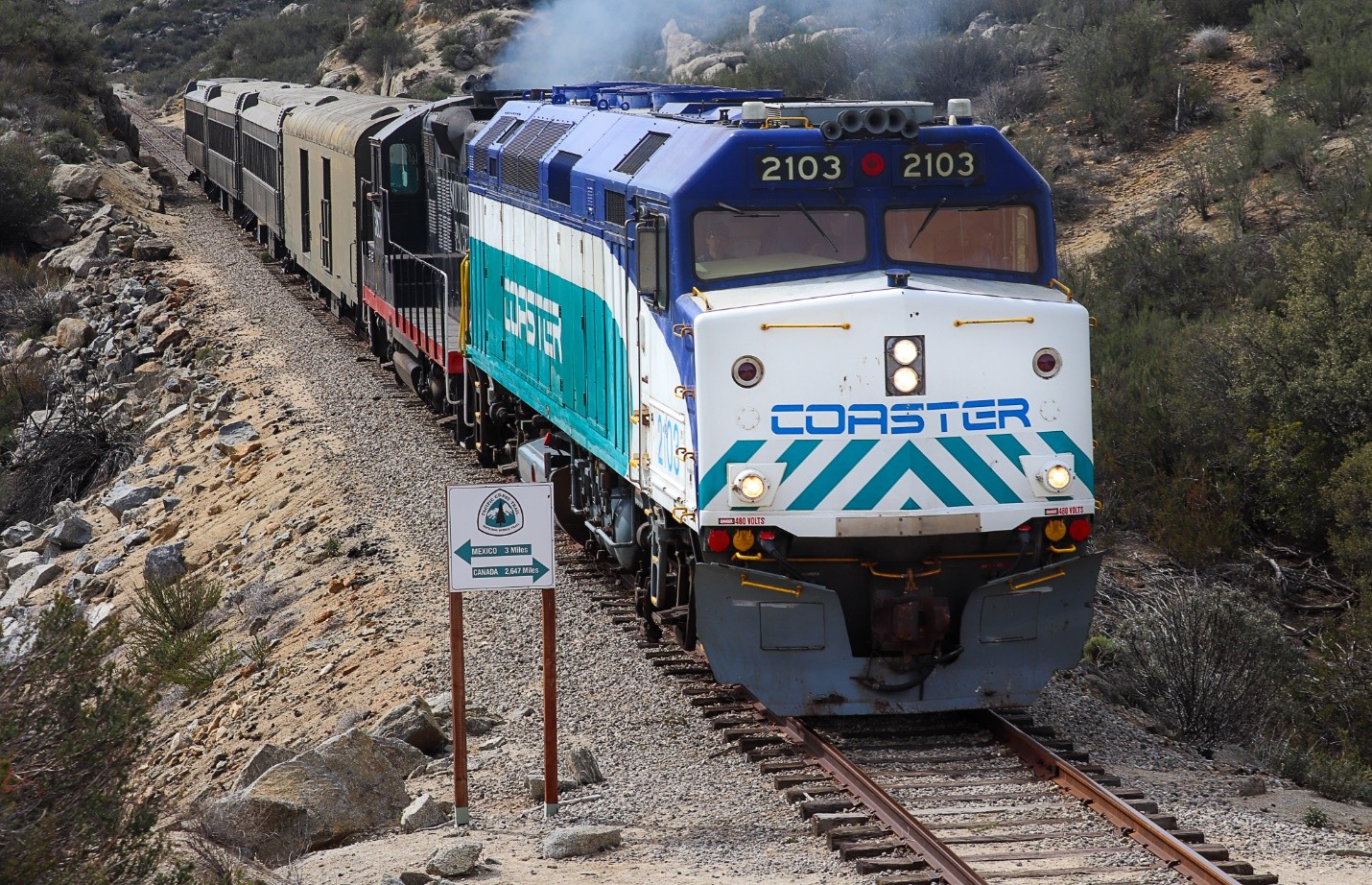
The North San Diego County Transit Development Board (NSDCTDB), now known as the North County Transit District (NCTD), began planning for the Coast Express Rail (Coaster) commuter train service in 1982. The service would operate over 41 miles of the Atchison Topeka and Santa Fe Railway’s (ATSF) Los Angeles Division – Fourth District from Downtown San Diego to Oceanside and would include 8 stations. NSDCTDB and the San Diego Metropolitan Transit Development Board (MTDB) would later purchase the San Diego County portion of the Fourth District from ATSF. NSDCTDB formed the San Diego Northern Railway as an operating subsidiary in 1994 to maintain, enhance, and operate the Coaster service. The Association of American Railroads (AAR) assigned the SDNX reporting mark to this new railway.
The Coaster would operate with a dedicated fleet of brand-new commuter train equipment, consisting of diesel-electric locomotives and bilevel coaches. Some of the coaches would be built as cab-control cars with an engineer’s cab and controls on one end, enabling Coaster trainsets to operate in push-pull mode. This would allow trains to quickly reverse directions at the terminal stations, avoiding the need to run around or wye the trainsets at the end of each run. NSDCTDB awarded separate contracts in the early 1990s to Bombardier to construct 16 coaches (including 8 cab cars) and Morrison-Knudsen Corporation to construct five locomotives.
Morrison-Knudsen Corporation was an American civil engineering and construction company founded in 1912 with decades of experience in the railroad construction business, but was a relative newcomer in the locomotive manufacturing business. Morrison-Knudsen formed a subsidiary, MK Rail, in 1972 which began by rebuilding existing locomotives for railroads across the United States. Morrison-Knudsen’s entry into the new locomotive manufacturing business under the MK Rail banner was short-lived, lasting from approximately 1991 to 1993. In 1993, Morrison-Knudsen spun off MK Rail as an independent company, which became publicly traded in 1994. Morrison-Knudsen Corporation filed for bankruptcy and went defunct in 1996. At that time, MK Rail rebranded itself as MotivePower, Inc. It continued as an independent company until 1999 when it merged with the Westinghouse Air Brake Company to form Wabtec. MotivePower survives as a brand under the Wabtec umbrella to this day.
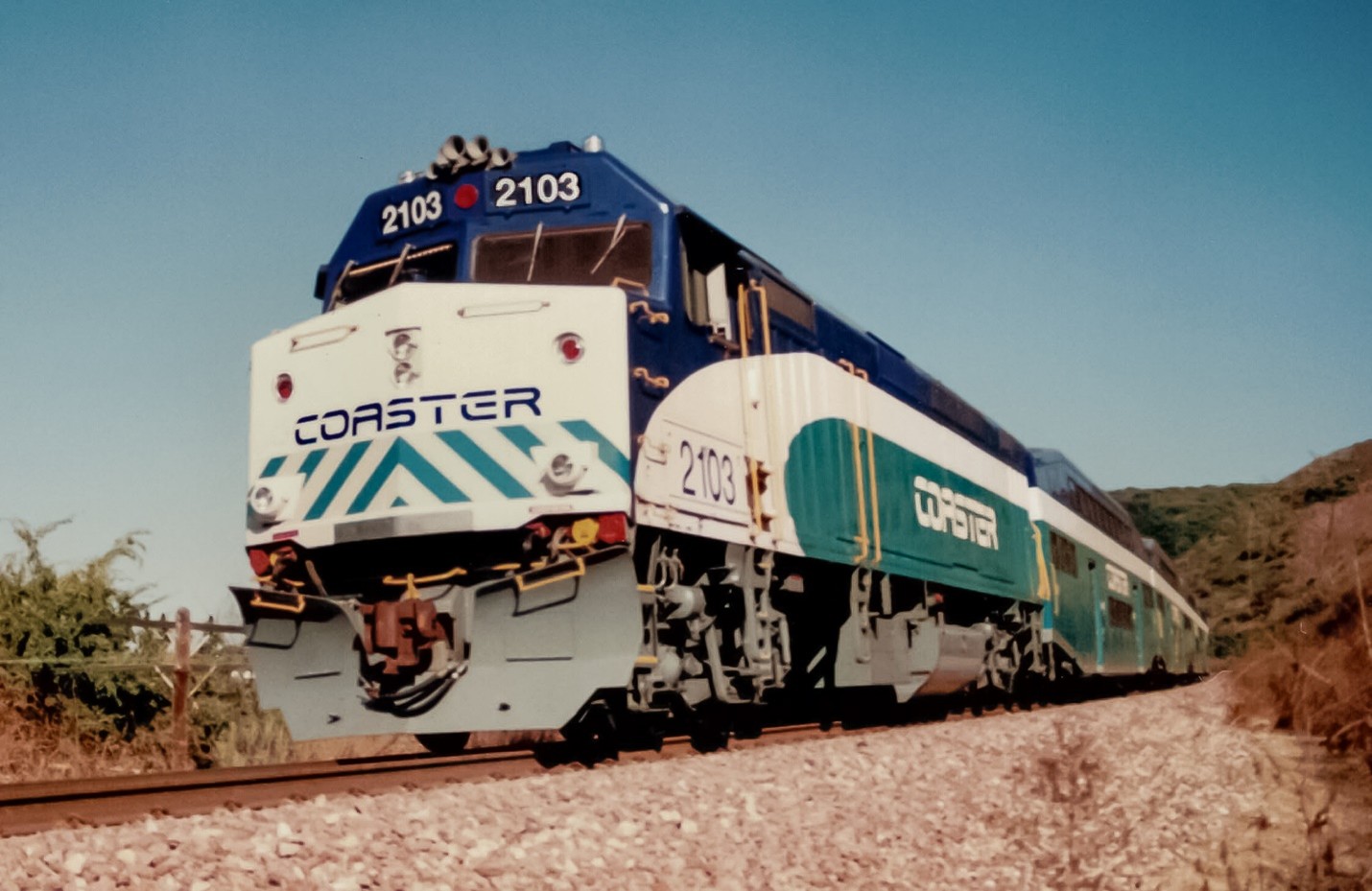
Coaster (SDNX) 2103 is an F40PHM-2C diesel-electric locomotive built by MK Rail in September 1994 at their Boise, ID manufacturing plant. It was part of Order #92003 and rolled off the production line with Serial #1193-03. MK Rail borrowed heavily from the design of the earlier F40PH locomotives produced by the Electro-Motive Division of General Motors and would use many off-the-shelf remanufactured EMD components to produce its new locomotives. However, these new locomotives would differ from the earlier EMD locomotives in that they have a lengthened frame and carbody to accommodate a separate powerplant for producing Head End Power (HEP) for passenger cars. The earlier EMD locomotives used an alternator connected directly to the prime mover to supply HEP, which required the prime mover to be locked at full RPM anytime HEP was needed. This also robbed some of the prime mover’s available horsepower that would otherwise be used for tractive effort. The separate HEP powerplant in the new F40PHM-2Cs used a smaller, more fuel-efficient diesel engine that could be run constantly at a high RPM, allowing the prime mover to operate through its full RPM range and deliver its full horsepower for tractive effort. Another feature that differentiated the F40PHM-2Cs from the earlier F40PHs was their use of the more modern “desktop” control console; the earlier F40PHs were equipped with a traditional “AAR” control stand.
SDNX 2103 has a 16-cylinder 645-E3C, W/J72 prime mover supplied by EMD which produces 3,000 hp at 904 RPM. It was originally equipped with an MK-LOC Microprocessor control system, replacing many of the electromechanical control relays that were used in older generations of diesel-electric locomotives. It is equipped with an AR10 Main Traction Alternator with a rectified output of 600 Volts DC (nominal) and a maximum continuous current rating of 4,200 Amperes. The main alternator is coupled to a D14 companion alternator with a nominal output of 215 Volts AC. The prime mover also drives an auxiliary generator that produces the 74 Volts DC needed to power the locomotive’s control systems and lights, and to keep the batteries charged. The locomotive has D78 traction motors on each of its four axles with a gear ratio of 57:20, enabling the locomotive to achieve a top speed of 102 MPH.
The HEP powerplant consists of a 6-cylinder Cummins KTA-19-G2 diesel engine coupled to a Marathon 571RSL4534 alternator. With the HEP engine running at 1,800 RPM, the alternator produces 3-phase, 60 Hz, 480 Volts AC power, with a maximum output of 425 kW. This was sufficient to power the lights, air conditioning, and other appliances on a 6+ car Coaster train. The locomotive weighs approximately 277,000 pounds (138.5 tons) and is 64’-3” long over the coupler pulling faces, 10’-8 ¾” wide over the hand rails, and 15’-5 7/8” tall over the cooling fan guards. It has dynamic braking and is Multiple-Unit capable. The fuel tank holds 2,000 gallons of diesel fuel.
Coaster service was inaugurated on February 27, 1995. It initially operated five roundtrips per day on weekdays only. Over time, NSDCTDB (and later NCTD) would gradually increase weekday service and added weekend service; first on Saturdays, then finally on Sundays. To accommodate the service increases, additional equipment was ordered. Six additional Bombardier coaches were delivered in 1997, followed by another six (including two more cab cars) in 2003. In 2001, two F59PHI locomotives from EMD were delivered to supplement the F40PHM-2C locomotive fleet.
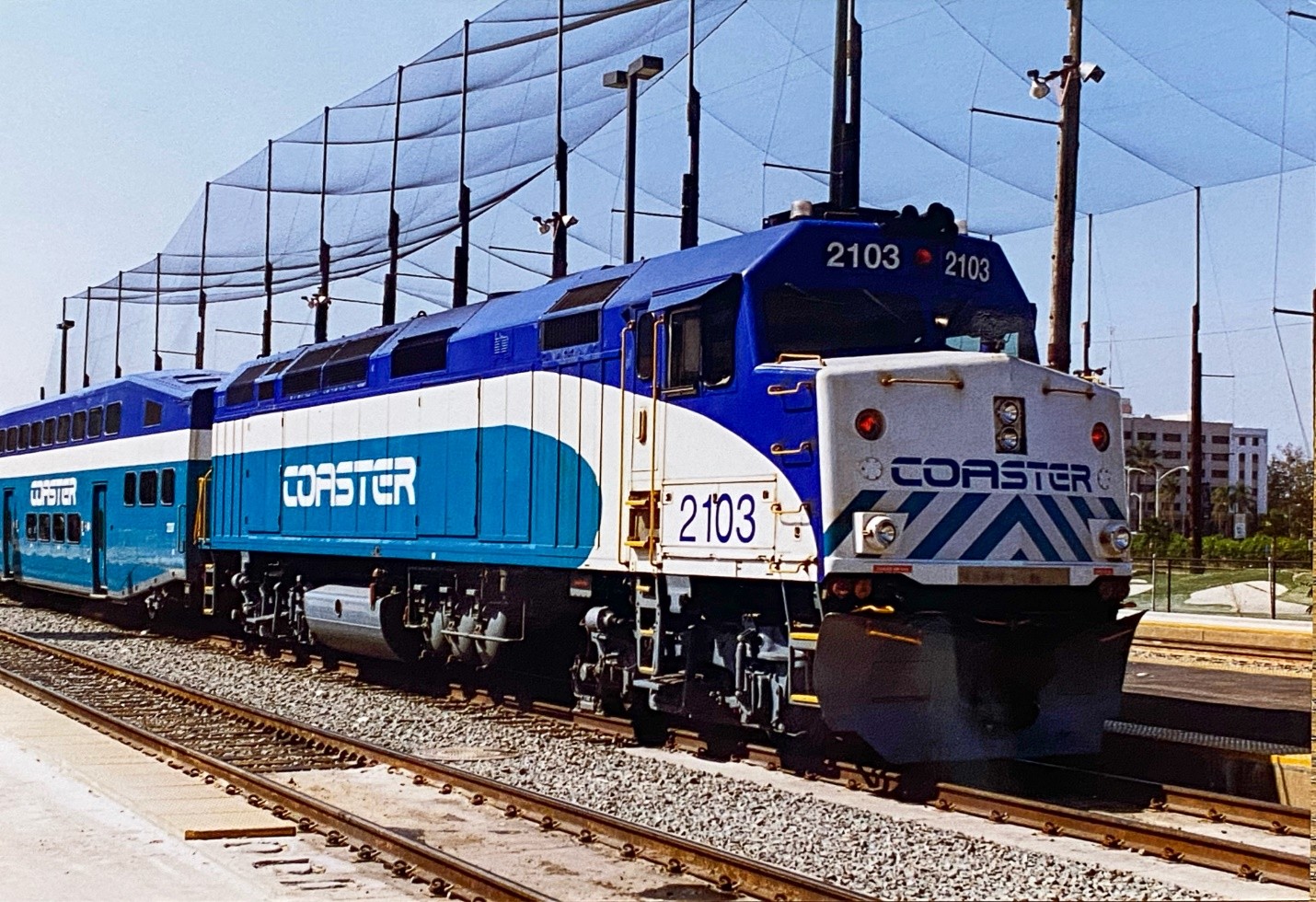
Beginning in 2002, NSDCTDB began a mid-life overhaul program for the F40PHM-2C locomotives. The locomotives were sent one at a time to Altoona, Pennsylvania where they would be rebuilt by The Norfolk Southern Railway under contract at their Juniata Heavy Repair Shops. There the locomotives would undergo a cosmetic refresh and a heavy overhaul including mechanical and electrical upgrades. The original MK-LOC Microprocessor control system was replaced with the newer Wabtec Q-Tron QES III system. SDNX 2103 was the final locomotive to go through this overhaul program between the summer of 2007 and spring of 2008.
In 2008, US Congress passed the Rail Safety Improvement Act which mandated the development and implementation of Positive Train Control (PTC) on most Class 1 Freight, Passenger, and Commuter railroads in the United States including the Coaster. PTC uses a combination of wayside, onboard, and “back office” equipment to prevent stop signal violations, train collisions, and temporary and permanent speed restriction violations. Between 2011 and 2015, NCTD installed PTC equipment on the F40PHM-2C locomotives including computer displays with softkeys, processors, radio equipment, and additional air brake equipment. The addition of computer displays to the control consoles required the air gauges and radio panels to be relocated, which was accomplished with some crude torch cuts to the control consoles in NCTD’s Stuart Mesa shop.
In 2014, NCTD dissolved the San Diego Northern Railway and began operating the Coaster service under the new reporting mark NCTC, standing for North County Transit Coaster. Although NCTD updated the F40PHM-2C locomotives’ reporting marks in their internal records, their original SDNX reporting marks would remain on file with the AAR.
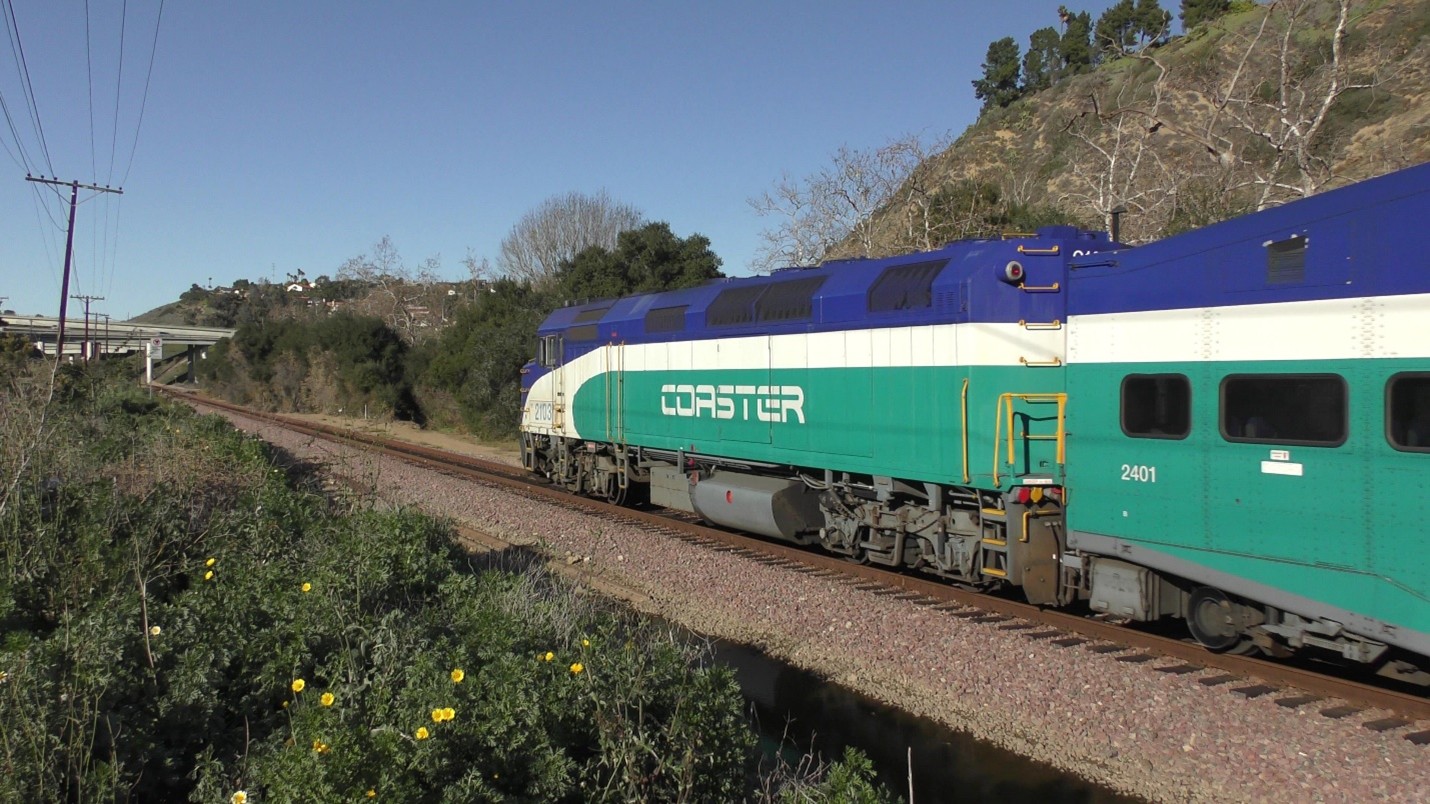
In early 2018, NCTD publicly announced that it would be retiring and replacing the F40PHM-2C locomotives with Siemens SC-44 Charger locomotives. NCTD applied for and received a grant through the California Air Resources Board’s Carl Moyer Memorial Air Quality Standards Attainment Program to pay for the new locomotives. The original grant terms required the locomotives being replaced to be scrapped to prevent them from continuing to pollute. The Pacific Southwest Railway Museum Association first reached out to NCTD in March of 2018 requesting the donation of one of the F40PHM-2C locomotives. It would take four and a half years for SDNX 2103 to finally make it to Campo. During this process, PSRM was able to get CARB to modify the Carl Moyer Grant language so that the locomotive could be preserved, but with the prime mover and HEP engine disabled by cutting holes in the engine blocks. A full writeup on the acquisition can be viewed here:Historic Coaster Locomotive 2103 comes to Campo
SDNX 2103 and the rest of the F40PHM-2C fleet was officially retired from revenue service on February 5, 2021; just a few weeks shy of the 26th Anniversary of the start of Coaster service.
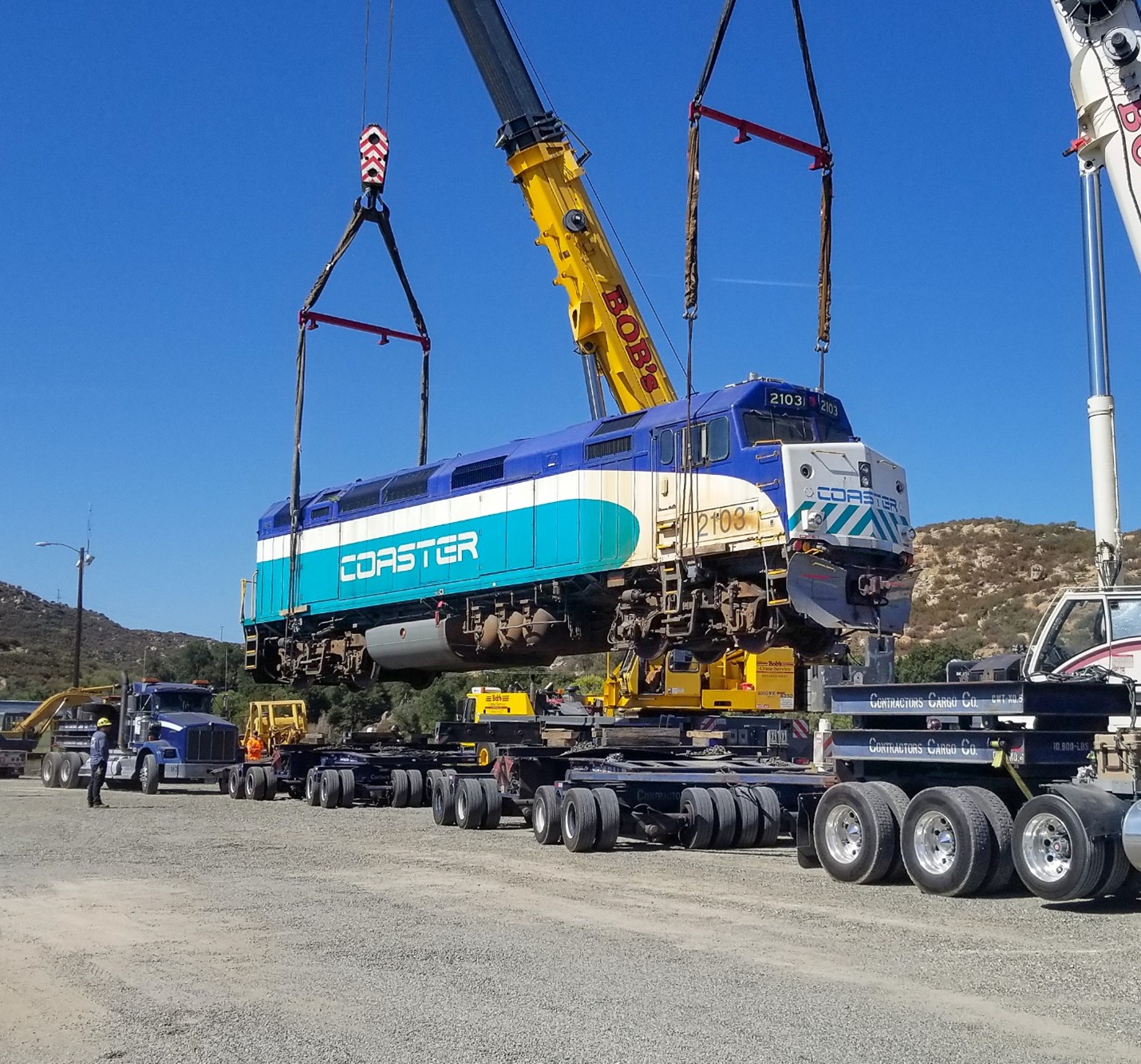
SDNX 2103 arrived at Campo by truck and was offloaded on August 9, 2022. Museum volunteers made a few minor repairs over the next few months and the locomotive is now operational as a non-powered control unit. It leads trains at the museum on special occasions, MU’d with one of the museum’s GP9 locomotives for motive power. It will continue to receive cosmetic repairs in the future as time and funding permit.
2025 Pacific Southwest Railway Museum Association. S. Hager