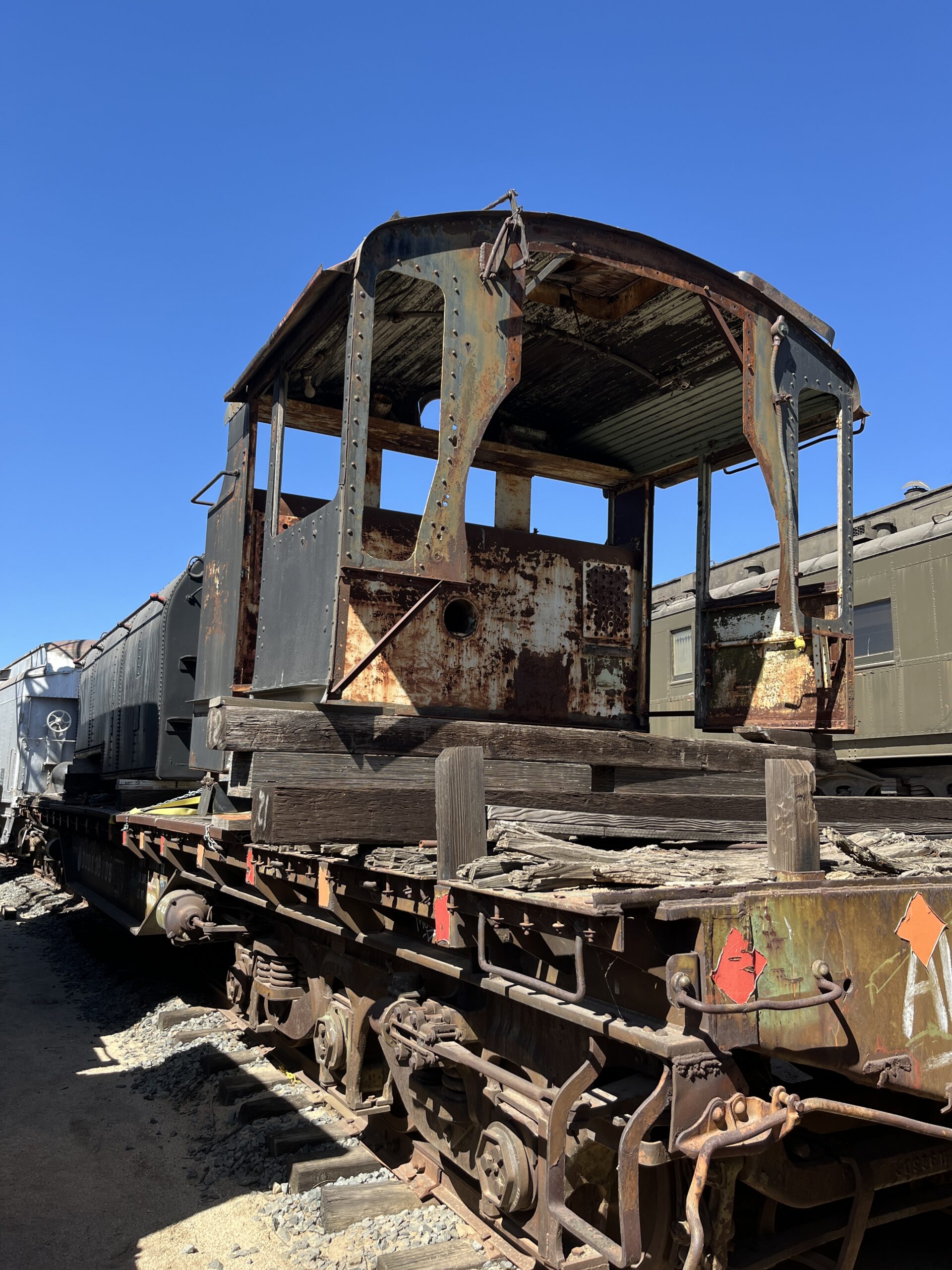
Coos Bay Lumer Co. #11
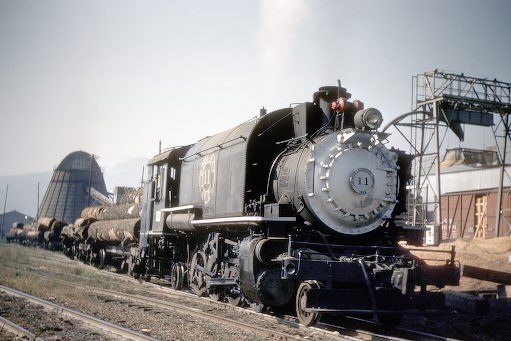
Information: Coos Bay Lumber Co. #11
| Type | Steam Locomotive (2-8-2T) Mikado “Minarets” road engine (named after the lumber company to first order this type locomotive) |
| Built | 1929 by American Locomotive Company, Schenectady, New York |
| Weight | 196,000 lbs. (98 tons) |
| Size | 20″ x 24″ cylinders, 44″ driving wheels, a 190-lb. boiler pressure (originally 200), and a tractive effort of 35,200 lbs. |
| Service History | The locomotive went new to Coos Bay Lumber Company of Powers, Oregon as No. 11. It was used in timber operations and along a 45-mile Southern Pacific branch between Powers and Marshfield (now Coos Bay), via Myrtle Point and Coquille in southwest Oregon. While in log-hauling service, CBL No. 11 often hauled cars up a 12-mile 5.5% grade (including 1,000 feet at 6%) with a maximum curvature of 18 degrees, to the Eden Ridge area. It also took up to 63 loaded cars on a 44-mile line from Powers to a company mill. Because of the curvature of the hill lines it worked on, CBL No. 11’s bearings, often got very hot. It was retired from log-hauling in early 1951 and used mainly in yard operations. In July 1956, Coos Bay Lumber was purchased by the Georgia-Pacific Corporation, becoming its Coos Bay Timber Division. Diesels then replaced steam and CBL No. 11 was used only in standby service. It pulled its last train at Myrtle Point’s Centennial in July 1962. |
| Retired | 1962 |
| Acquired | November 1967 via donation. Brought to Campo in July/August 1983. |
| Current Status | Disassembled for boiler inspection, awaiting restoration to operation. Requires repairs to the firebox, frame, and running gear to operate again. The locomotive is currently disassembled to allow access to the boiler for ultrasound testing. The current estimate to return this locomotive to operations is approximately $800,000 – $1,000,000. We need your help to restore the Coos Bay #11 back to operational status. Every donation brings this closer to reality. Please donate to the Steam Fund" |
| More Information | Operated by the volunteers at the Campo Railroad Museum in 1985. Because it has no tender, is doesn’t have the ability to operate over long distances. However, that also allows it to operate over rough track with better visibility when backing. In addition, the water in the tank adds weight to the driving wheels, giving it the ability to pull heavy loads. Lyle McCulloch, Sr., who worked on the line from 1925-71 (as engineer after May 1934), often operated CBL No. 11, and was fireman on its first run in 1929 |
Southern Pacific #2353 Gallery
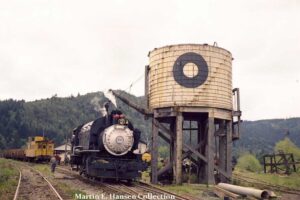
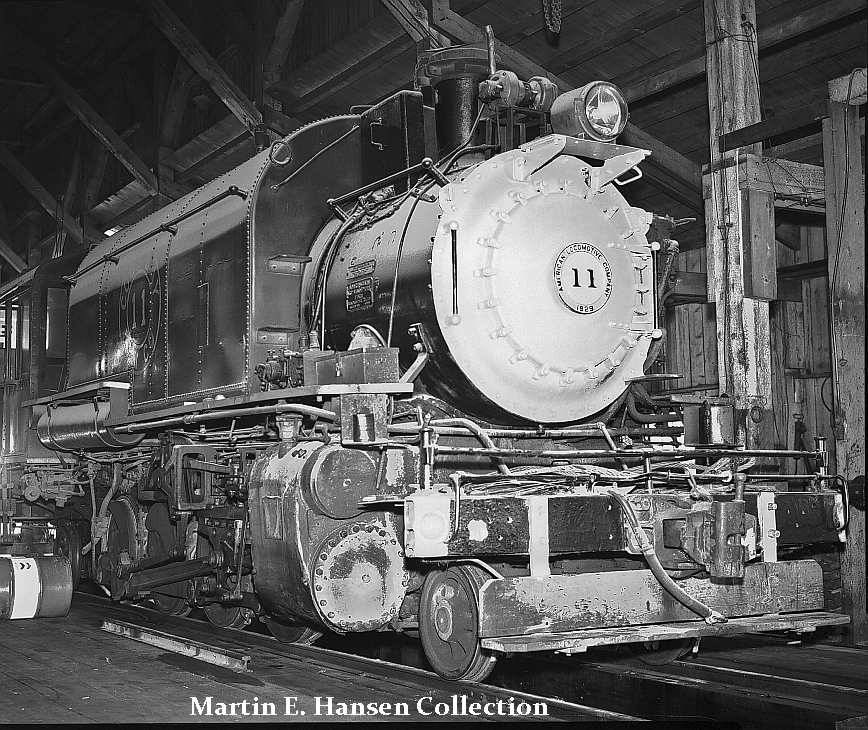
- On May 7 of 1961, Coos Bay #11 takes on water and oil outside the shops at Powers, OR in preparation for taking a group of Boy Scouts on a train ride. Photo by R. E. Burke - Martin Hansen Collection.

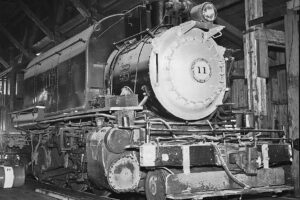
- Off the back of track #2 in the Powers, Oregon machine shop of the Coos Bay Lumber Company, #11 sits waiting for its next assignment. Photo by Jerry Hansen December 1956. Martin E. Hansen Collection
Restoration History
Below is a diary of the restoration work performed on the Coos Bay Lumber Co. #11.
2010
In 2008, we contracted with a very experienced and respected locomotive boiler inspector, Dave Griner, of Arizona Mechanical Engineering, to examine the boilers on both Southern Pacific 2353 and Coos Bay 11.
It was decided that Southern Pacific 2353 would be too expensive to restore at this time (see SP #2353), so we continued to evaluate Coos Bay 11. Mr Griner was optimistic in his visual examination of Coos Bay 11. Because it is such a major part of the locomotive, and probably the most expensive to repair, the boiler will be the first thing to take a good look at.
In addition to a visual examination, it will be necessary to do a complete ultrasound examination of the boiler to determine the thickness of the steel. Areas that have eroded to the point that they would be unsafe under pressure will need to be replaced, so the ultrasound testing will determine the extent of repairs needed to the boiler. Certainly, repairs to other parts of the locomotive will also be needed.
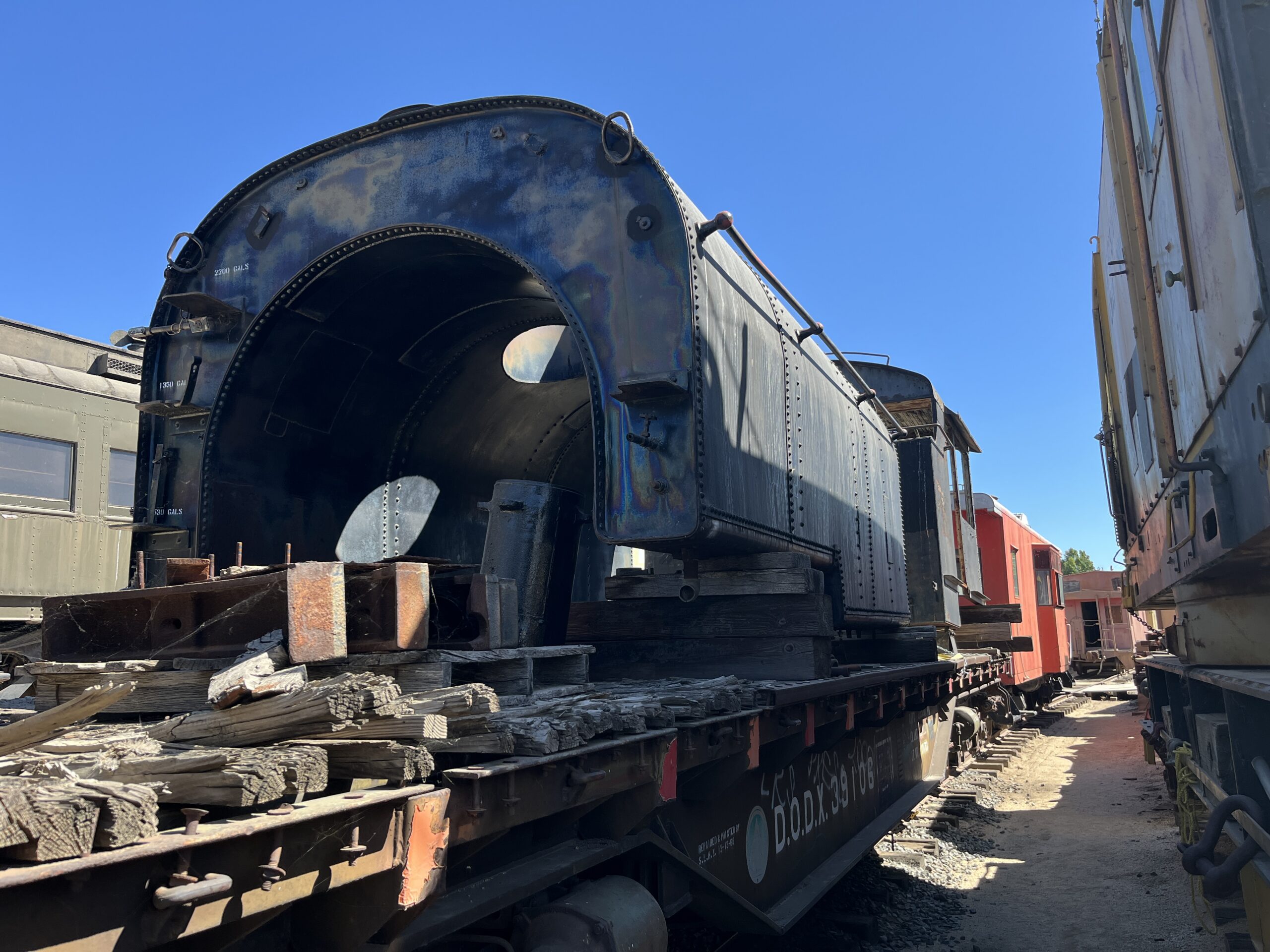
In order to get a good look at both the exterior and interior surfaces of the boiler, it would be necessary to remove the outer jacket and asbestos insulation, and all the boiler tubes. Then, all the accumulated scale and other crud that has collected inside the boiler would have to be cleaned out.
Fortunately, a number of years ago, a generous donor had agreed to do asbestos abatement work on all five of the steam locomotives we have at Campo. As part of that process, the saddle tank and sheet metal jacket had also been removed, so the locomotive was ready for us to start doing our job.
During the past several years, our volunteers have worked on this project, putting in over 1,100 man-hours (including some woman-hours). Sometimes the progress was very slow, since a number of jobs required extensive “learning time.”
Tasks Completed in 2010
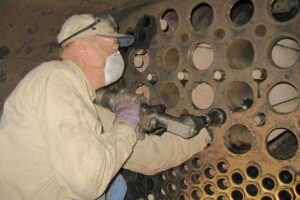
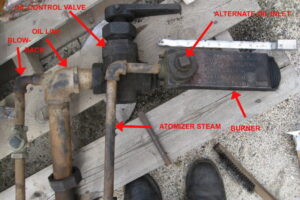
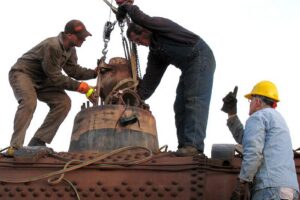
Removed the smoke box door and front. (See photo 1). The petticoat pipe, blast pipe, and smoke box baffle were removed. (See photo 2). Next the firebricks were taken out of the firebox. (See photo 3). All 26 superheaters units and the throttle spool were extracted. (See photos 4 & 5). Took out 23 of the 26 superheater flues. (See photo 6 & 7). Removed 160 boiler tubes. Short stubs remains at both tube sheets. (See photo 8). The oil burner was taken out. (See photo 9). The throttle and 14 of the 23 wash-out plugs were removed. (See photo 10).
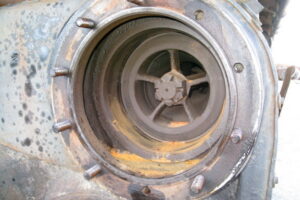
We wire-brushed and vacuumed out all the tubes prior to removal. The boiler’s interior was pressure washed. both sand domes were cleaned out. We lubricated the running gear so that the locomotive could be moved. The cylinder valves were inspected. (See ph0to 11). The cross-compound air compressor was boxed up and stored. Covers were made for the dry pipe and superheater header. A contractor sand-blasted the interior of the boiler. (See photos 12 – 15). The area around the mud ring was washed and vacuumed to remove any remaining sand.
The Steam Crew working on the Coos Bay were Bob ???, Jim Baker, Mike ???, and Rich Paulus. (See photo 16).
Remaining tasks for 2010
Lubricate running gears. Remove the tube stubs from the front tube sheet. Remove remaining wash-out plugs. Draw a 1 ft. x 1 ft. grid on the boiler for the ultrasound measurements.
Status at end of 2010
Lubricated running gears. All wash-out plugs have been removed, lubricated, and reinstalled to keep out the rain. A plywood cover for the front of the smoke box was fabricated and installed. Most of the 1 ft. x 1 ft. grid has been drawn on the boiler.
Tasks for 2011
Finish removing the tube stubs from the front tube sheet. Finish drawing the ultrasound grid. Perform the ultrasound testing of the boiler.
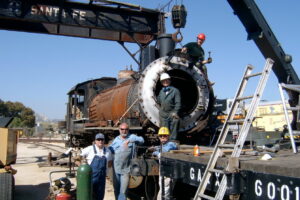
- Photo 1

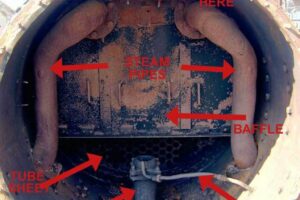
- Photo 2

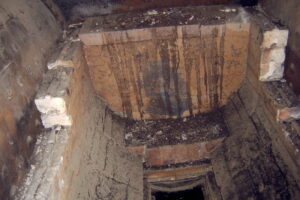
- Photo 3

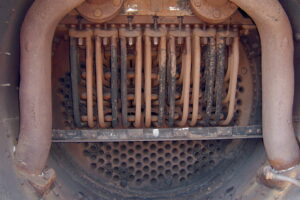
- Photo 4

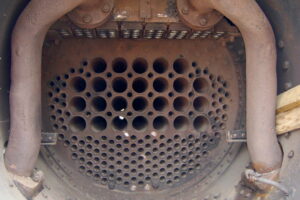
- Photo 5

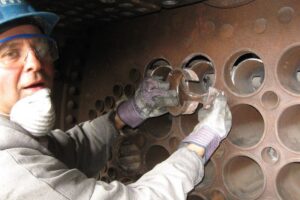
- Photo 6

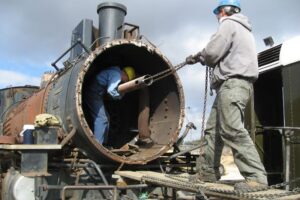
- Photo 7

- Photo 8

- Photo 9

- Photo 10

- Photo 11

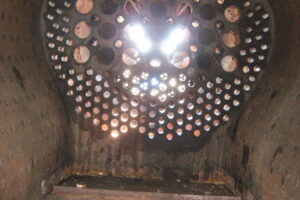
- Photo 12

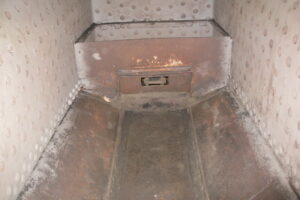
- Photo 13

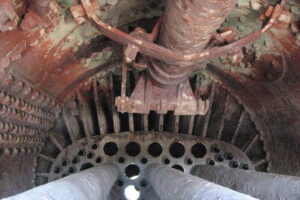
- Photo 14

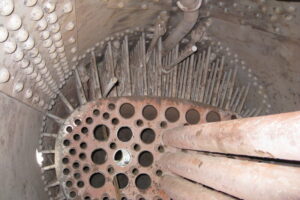
- Photo 15

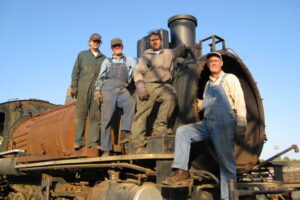
- Bob, Jim Baker, Mike and Rich Paulus

September 2014
In the last few years since our update of 2010, we have accomplished the following:
- All tube stubs have been removed from the front tube sheet. Except for a few nicks caused when removing the tubes, it is in good shape.
- A 1′ by 1′ grid has been drawn on the entire boiler.
- Ultrasound thickness measurements were done by Dennis Daugherty at each point on the grid, completing the ultrasound examination of the boiler, dry pipe and front tube sheet. Earlier visual examinations indicated that with the exception of the lower one third of the firebox sheets, the boiler was in good shape. The ultrasound exam confirmed this. No significant thin spots were found.
- The welded tube ends had not been removed from the rear sheet, so a complete exam of the rear sheet still needs to be done. About half of the tube ends have been removed. The lower portion of that sheet, along with the lower portions of the side and door sheets show a lot of corrosion, so will need replacing. There appears to be a crack at the top along the knuckle.
- The front heads on both cylinders were removed, and the interiors inspected. No significant wear was observed; there was some light rusting. The diameters were checked with a micrometer, and found to be round within a few thousandths of an inch. The pistons can be moved freely back and forth.
- Lots of crud has been scraped off the frame and running gear, and the entire locomotive was steam cleaned.
- The FRA (Federal Railroad Administration) requires that all the flexible staybolt caps be removed to help determine if the bolts are intact. Since it has probably been 40 or 50 years since this has been done, removal of each cap can be difficult. We remove the cap, clean out the crud that has built up, clean and grease the threads, and replace the caps. This will make it much easier to remove the caps when we actually test the staybolt integrity. There are literally hundreds of staybolt caps on the firebox. So far we have removed and cleaned just about all that are above the cab floor, but there are LOTS MORE below the floor.
- The firebox ends of the tubes are seal welded. While the tubes themselves have been cut out; short, welded-in stubs remain, and the welds must be ground off. There are about 160 two inch tubes and 26 five inch flues. So far, about half the welds have been ground off.
- The axle diameters have been measured, and it looks like they are all okay.
- We have started removing the “plumbing” that runs below the cab and running boards so that we can get at the lower staybolt caps.
- The Board approved our request to hire Mr. Efstathios “Stathi” Pappas, as a consultant. Stathi, was the chief mechanical officer of Mt. Rainier Scenic Railroad, and recently finished a complete overhaul of their Hammond Lumber Co. #17, a near twin to Coos Bay #11. His experience in working on #17, gives him a very good idea of what to look for on the Coos Bay. He came to Campo in mid-October to look at the Coos. (He is now the Curator of Collections at the Northwest Railway Museum, in Snoqualmie, WA)
- “Form 4″ calculations for the boiler are being done by Ron Amberger, a new volunteer in the last year. He is a Professional Engineer, and is qualified to do these calculations, and has previously done several Form 4 calculations for other locomotives. These calculations, using the ultrasound thickness measurements, size of various braces, etc. are used to calculate a theoretical “strength” for the boiler. These calculations need to show that the boiler can handle a pressure four times higher than the actual working pressure of the boiler.
- Stathi’s report has been received. The quick, short, summary is, “This locomotive will not be an easy restoration, but is quite achievable given institutional commitment to the project, and the realization that its return to steam will be a multi-year project requiring grant money and aid from other institutions with the more technically challenging aspects……… If this locomotive was part of this author’s fleet, the work could be completed in three years for approximately $200,000.”
- The biggest “surprise” from Stathi’s report is the following: “First, and perhaps most interesting is the fact that it appears all the frame connections leading to and from the cylinder saddle were broken and welded back together. It is possible that this occurred during one catastrophic event, or could have been the cumulative results of long term heavy service and/or abuse. The weld repairs appear to have been very competently carried out in terms of their outward appearance. However, it would be good insurance to radiograph some or all of these welds before investing a great deal of resources into the locomotive in order to prevent surprises later such as incomplete penetration, incomplete fusion, or extensive internal flaws. Regardless of the quality of welding, this condition is something that warrants careful observation if the engine is returned to service to ensure the welds do not begin to crack.”
- As a consequence of the above, we spent some time wire-brushing and scraping more crud off the frame so that the welds could be tested. Due to scheduling conflicts, both with the testing company and at the museum (crew shortages), we were not able to have the welds looked at until the end of May. Decisive Testing, Inc. did the job as a donation. THANK YOU! The technician was able to tell us that several of the welds were good, one had an obvious crack, and some others were located where he couldn’t get his testing instrument. His recommendation was that we try to remove everything that we can that is in the way, thoroughly clean the frame, and test it with dye penetrant.
Next Steps
Outside, we steam cleaned the frame, but to start removing the things that obscure the frame, the brake and spring rigging, we will need to access the pit for a few days. This may happen in September.
Because of the delays in accessing the shop, I decided that we really need to have a more permanent place to work on the Coos Bay. Also, since the board recently met to come up for goals and plans for the future, I asked them to tell me where steam fell in their priorities, and if we could have a fixed location to do our work under some type of shelter. They approved us setting up a work shelter for the Coos at the west end of Track 11 (under the ATSF gantry crane). Depending on budgeting and space required, this space may be a tent-type fabric-covered one or a metal car port type.
Once we can access the pit, we need to remove the brake rigging, at least that part of it that is under the axles, so it will be easier to crawl under the engine when it is under the work shelter. Once we get all the brake rigging removed, we’ll need to remove the spring rigging. To do that we’ll need to jack up the engine to take the tension off the springs.
Once all the brake and spring rigging is removed, we will be able to thoroughly clean the frame, and test with dye penetrant. I’m guessing that this will take most of 2015 to accomplish.
September 2016
In the last few years since our update of 2014, we have accomplished the following:
- Removed all the brake rigging (except for 1 of the 4 brake beams that is being really stubborn we should have it off this month).
- Removed all the springs and spring rigging.
- Erected a 50 ft long carport over the Coos. The shade it provides is a real life-saver during the summer.
- Cleaned both main frames and looked for welds and looked for cracks using dye penetrant. We found a total of 8 welds; two cracks in one very large weld and one crack in a smaller weld.
- Painted the cleaned areas of the frame with gloss black Hammerite® paint.
- Ground off the seal welds on many more tube stubs on the rear tube sheet. The tube stubs were then removed.
- The remaining tube stubs should be removed by October, 2016.
- We had previously noticed that the fuel tank was still about 40% full of fuel, of unknown composition and was at least 30 years old. Because of those factors, and the need to reduce the weight to jack up the rear end to remove the third set of springs, our waste oil hauler removed most of it in December, 2015. We were able to drain off the remainder in February, 2016, and transfer it to our waste oil tank.
- Since Jan. 1, 2006, our group has put in 5,197 hours working as a group, with 4,259 hours actually working on the Coos Bay. That works out to 650 8-hour days for the group total, and 532 days, or 82% of our total time working on the Coos. There are about 22 working days in a month so we have put in the equivalent of about one person working full time for only 24 months on the Coos Bay. So, for comparison, Union Pacific’s full time steam crew of about 6 (including our former volunteer, Jimmy Thompson) could have completed what we have done in four months. Maybe less, since they know what they are doing!
We are now at a point where we can get a testing company to come out and check the welds for quality via ultrasound or radiography. Our consultant, Stathi Pappas has suggested that some existing boiler patches and a couple of areas suspected of having “grooving” be radiographed. I’ll be working on getting those tests done in the next month or two. After that, we should have a very good handle on what will need to be done to return the Coos Bay to operation. Our concentration then will be to get some good estimates on what it will cost.
Some images to help tell the story:
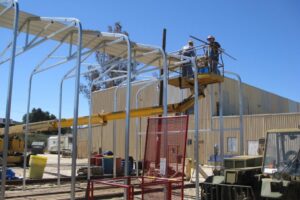
- Restoration volunteers attach roofing panels to the carport frame

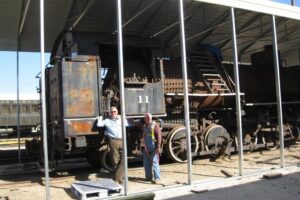
- Dick and Harry stand next to #11 in her new home. The completed shelter has panels extending an additional 8-10ft down the sides of the structure


July 2025
Jim Baker’s, Steam Foreman (Ret.), final report.
This will be the last report I will write concerning Coos Bay Lumber Co. #11. After approximately 20 years of intermittent work on that locomotive, we have come to the point where there is no further work we can do. We have disassembled the locomotive as far as we can. The purpose of this was to determine what all would be needed to restore it to operating condition, and to avoid as many surprises as possible if a restoration was started. Shown below is a summary of the MAJOR work that we know would need to be done to restore it to operation.
FRAME
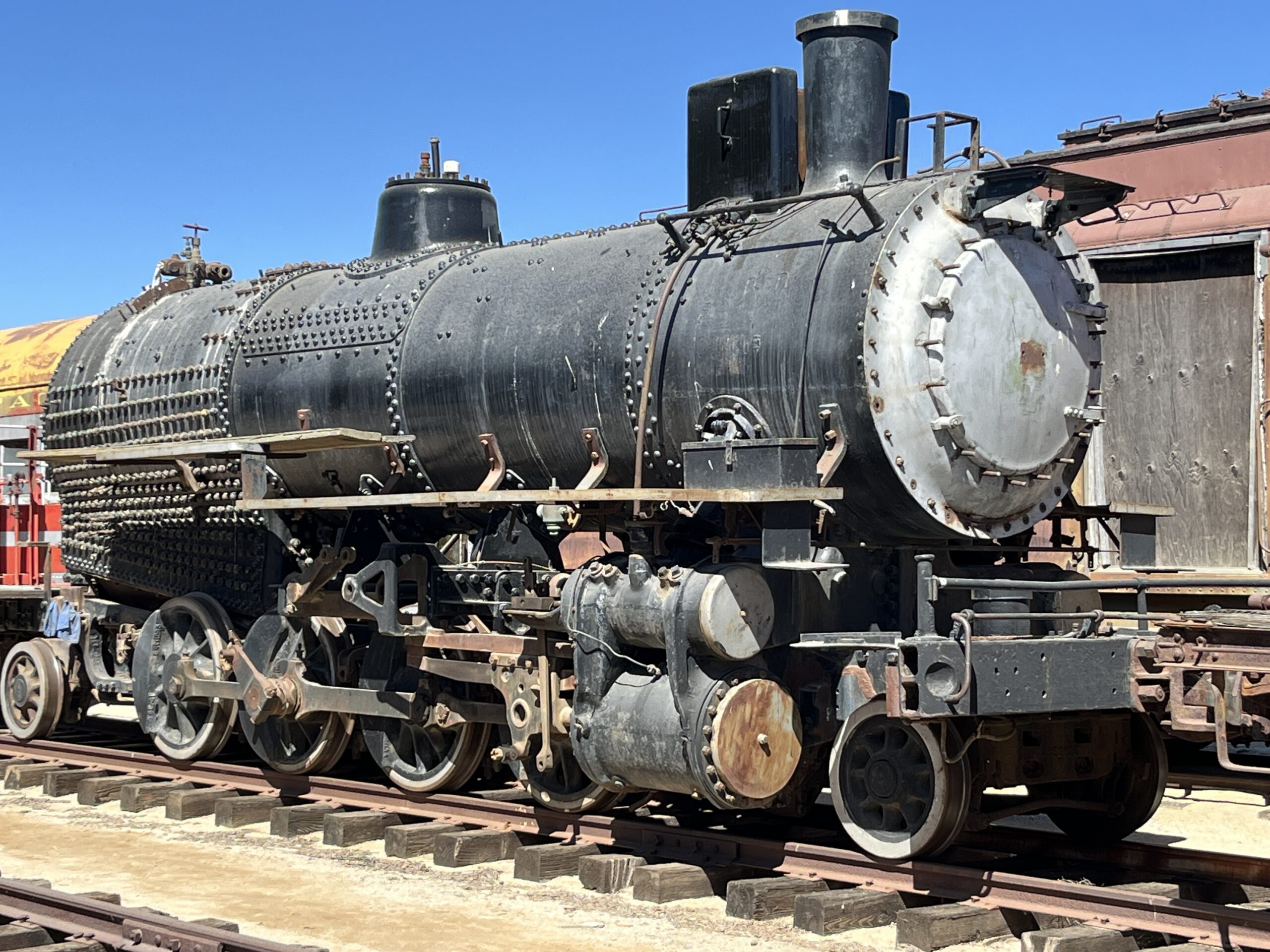
- Quoting a 2014 report from our consultant, Stathi Pappas, “All the frame connections leading to and from the cylinder saddle were broken at some time in the past and welded back together. It is possible that this occurred during one catastrophic event, or could have been the cumulative results of long term heavy service and/or abuse. The weld repairs appear to have been very competently carried out in terms of their outward appearance.” However dye penetrant testing we did at a later date showed two large cracks in the weld on the left frame. Note that the front pilot area is not in line with the rest of the frame; it is tilted upward toward the front. This will be a major job to repair. Additionally, the remainder of the frame was cleaned and tested with dye penetrant to look for cracks; a crack was found in the “bumper knee” an L-shaped piece that attaches the rear bumper to the left frame. A similar crack was found earlier on the right side. Also a crack was found in the left pedestal for the #2 axle.
BOILER
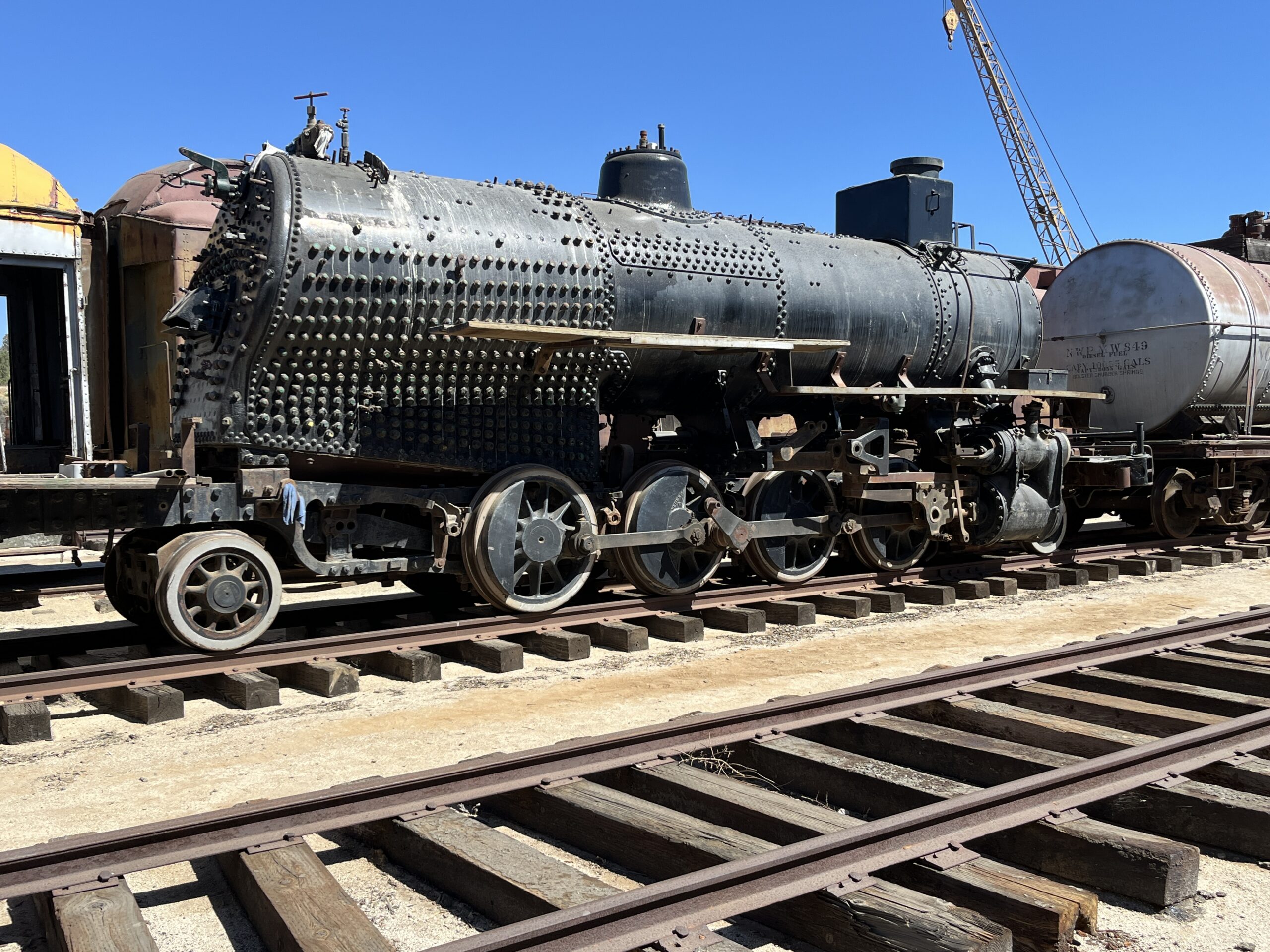
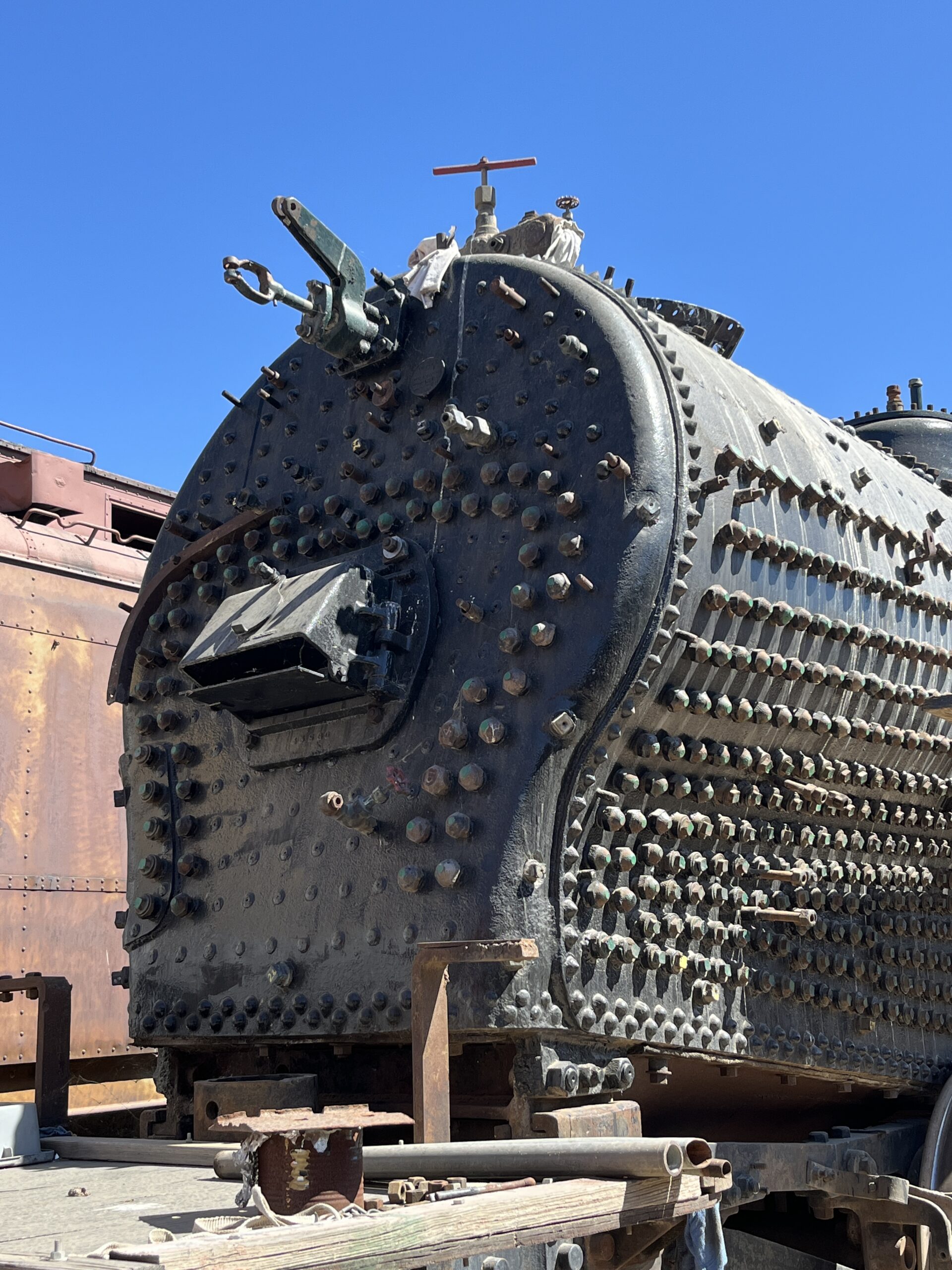
- Replace lower approx. ⅓ of all firebox sheets.
- Replace approx lower ⅓ of the smoke box.
- Rear tube sheet; A number of small cracks radiating from tube holes were found. It has not yet been determined if these are a significant factor that could require the entire sheet being replaced. If not significant, only the top portion will need to be replaced, due to an existing crack.
- Radiography analysis
- A radiography (x-ray) analysis by a contractor of several areas on the boiler showed following:
- There is a patch on the lower left corner of the back head that is not completely riveted. X-ray showed there is a crack under the patch.”
- The left and right sides of the throat sheet show cracking and weld (slag) inclusions. Cracking also seen in rivet/bolt area.
- There is a patch on the lower left side of the boiler drum. The X-ray showed some pitting/weld inclusions. The patch covers a welded crack visible on the inside of the boiler.
Member Ron Amberger did the FRA Form 4 calculations for us. If the defects noted above are repaired, the remainder of the boiler is serviceable.
- Repair or make a bracket for exhaust nozzle broken ears.
- All new jacket and lagging.
Running Gear
- Replace hub liners/wear plates on drivers.
- Turn pilot and trailing wheels.
- Lots of machining: crank pins, crosshead guides, wheel profiles on pilot and trailing wheels, shoes and wedges, along with pins and bushings on the valve gear. Axles/wheels will need to be quartered and trammed, valves timed.
- Overhaul the springs and spring hangers.
Brakes and Brake Rigging
- New pins and bushings in all brake rigging is needed, and we need to overhaul the brake valves, and replace all the brake plumbing.
Cab
- All new wood cab interior, including deck, ceiling, walls, window/door frames and glass.
Documentation
Daily maintenance reports were filled out each day any work was done on the locomotive. They are filed in the Mechanical Office. Similarly, JPG files of hundreds of photos taken during this work, along with a list of the photos are on a USB memory stick are filed there. Finally, a complete inventory of every part that was removed from the locomotive was prepared. The inventory lists each part, and where it is stored. A detailed report to the board was made in 2017. Not much of significance was found since then.
Estimated Cost to Restore
The detailed report that I wrote in early 2017 estimated that it would cost about $500,000 to restore Coos Bay #11 to operation. Considering inflation and other increasing costs in the interim, I would guess that a restoration to operation would cost somewhere in the area of eight hundred thousand to one million dollars.
Until such time that the board decides to either dispose of the engine or decides that a major fund-raising to restore the engine is possible, the engine will probably be stored in our yard.
Donate
We need your donations to get this beautiful steam locomotive back to operational status. All it takes is your help. Can you please Donate?
Some images to help tell the story:
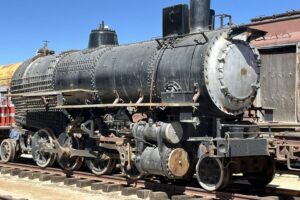
- Coos Bay #11 Front Right View
- Coos Bay #11 Right Rear View
- Coos Bay #11 Saddle Tank
- Coos Bay #11 Rear View of Boiler
- Coos Bay #11 Cab